

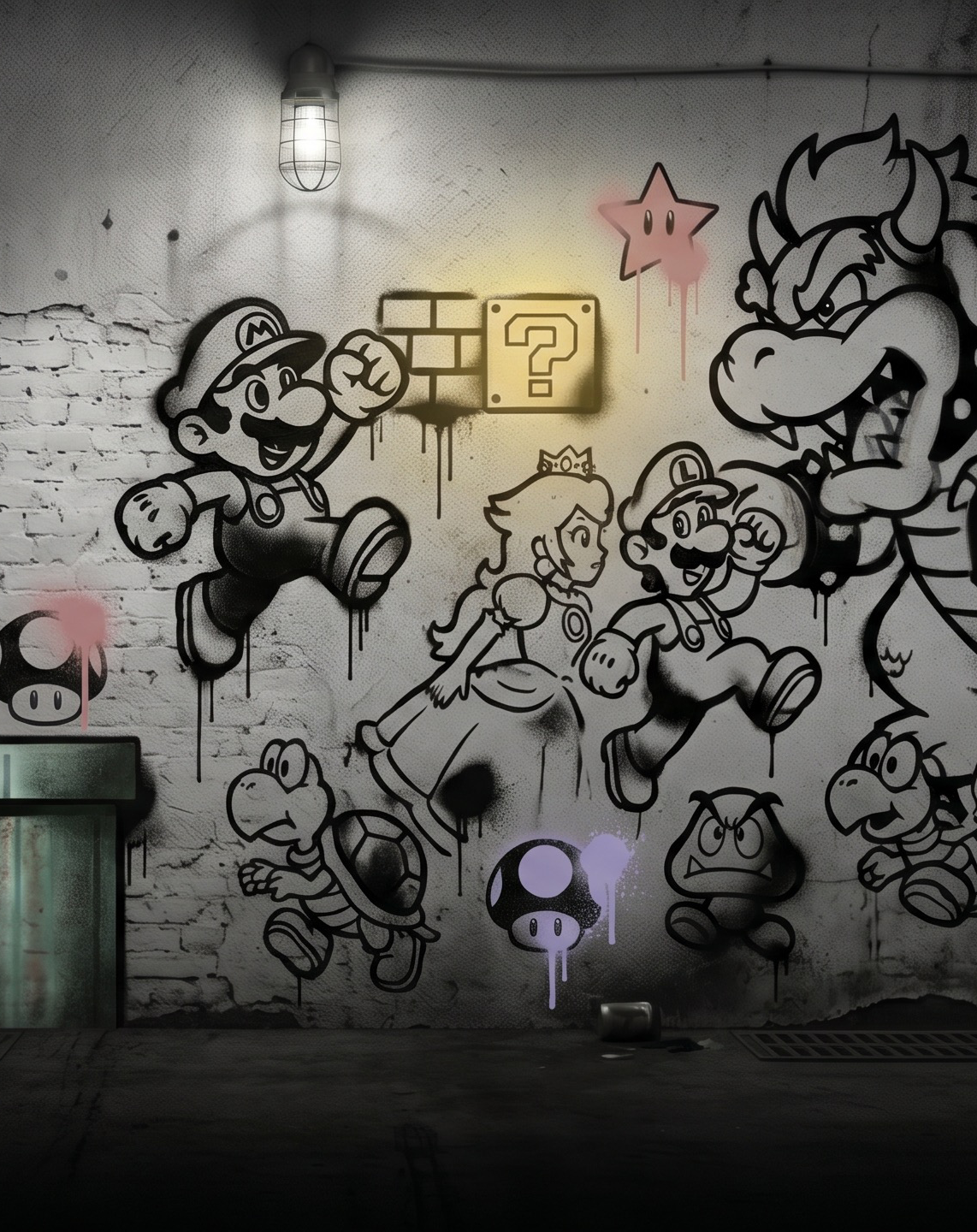
The Plumber Who Started as a Carpenter
Every great character has to start somewhere. For Mario, that somewhere was a warehouse full of failed arcade cabinets.
In 1980, Nintendo had a serious problem. Their arcade game Radar Scope had flopped in North America, leaving the company stuck with thousands of unsold machines. Rather than write off the loss, Nintendo handed the project to Shigeru Miyamoto, a young staff artist who had never designed a game before. What he built wasn't just a rescue job. It became the foundation of gaming's most successful franchise.
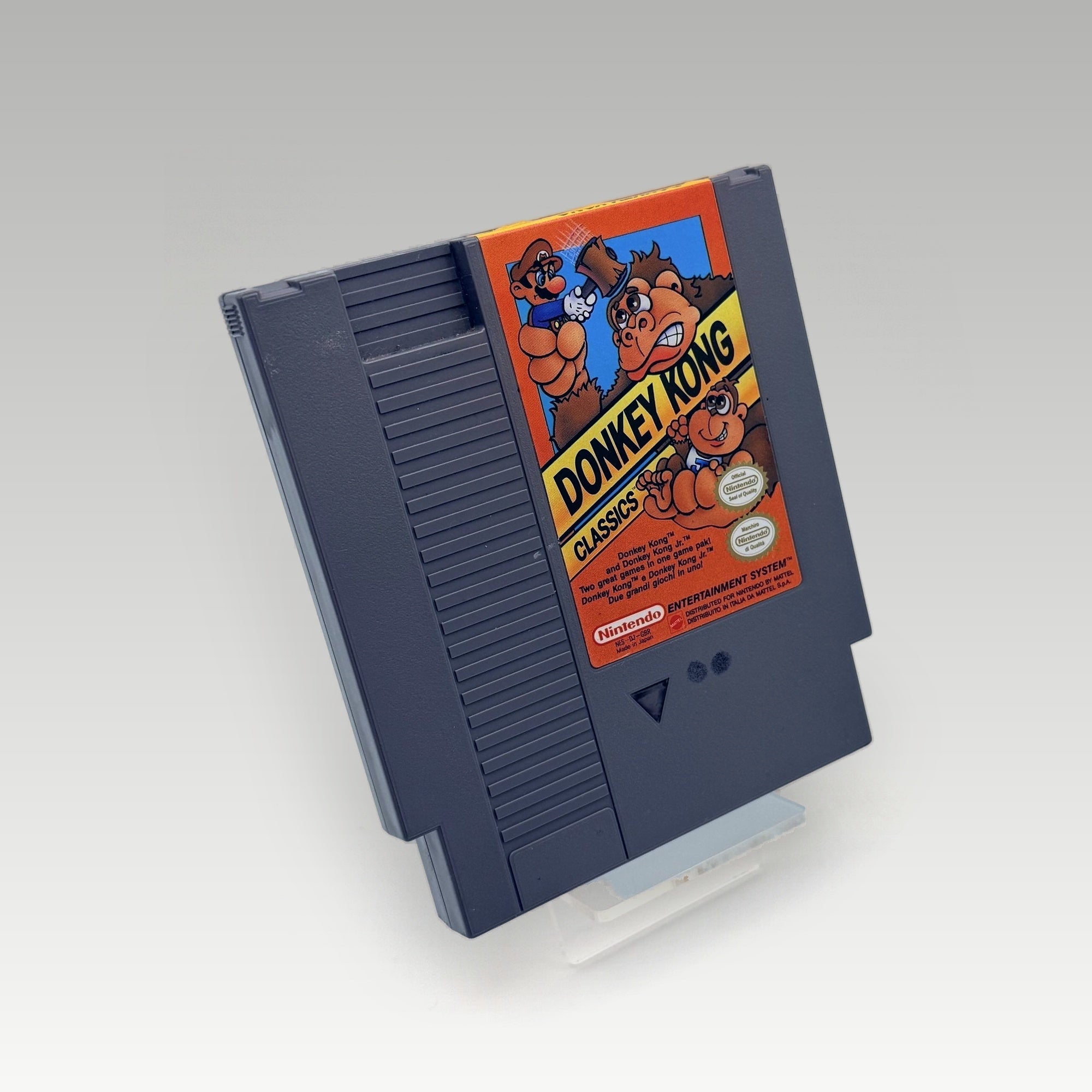
Donkey Kong hit arcades in July 1981. Players controlled a small, stocky character called "Jumpman" as he climbed scaffolding to rescue a woman from a giant ape. The character wasn't much to look at, and that was entirely deliberate. Miyamoto was working within a 16-by-16 pixel grid, and every design choice came down to what was actually possible at that resolution. A cap replaced hair because individual strands were impossible to render. A thick moustache defined his face because a mouth would have been invisible. Overalls in a contrasting colour made his arms visible while running. Every element that defines Mario's look today exists because of technical constraints from 1981.
The naming happened almost by accident. Nintendo of America rented warehouse space near Seattle from a man called Mario Segale. When staff needed a proper name for the character's Western release, they picked their landlord's first name. Segale apparently took it well enough. He told the Seattle Times years later that he was still waiting on his royalty cheques.
By 1983, Jumpman had officially become Mario. He'd gained a brother called Luigi, traded his carpenter's hat for a plumber's, and starred in Mario Bros, a co-op arcade game set in underground sewers. The pipes, the coins, the enemies crawling up from below. The building blocks of a Mario game were already falling into place.
The Game That Saved an Industry
The North American video game crash of 1983 nearly killed console gaming overnight. Retailers wouldn't stock cartridges, consumers had lost all confidence, and the entire industry looked like it might be finished for good. Nintendo's response was the Nintendo Entertainment System, and the game that sold it was Super Mario Bros.
Released in September 1985, Super Mario Bros did something that most games before it had never really attempted. It built a world that felt like it existed beyond the edges of the television screen. Players moved left to right through the Mushroom Kingdom, smashing question blocks, grabbing Super Mushrooms to grow taller, and picking up Fire Flowers to throw fireballs at Koopas. The level design was clever in a way that taught players the rules without ever needing a tutorial. World 1-1 remains one of the most studied and admired pieces of game design in the medium's history.
The game shipped as a pack-in with the NES in North America. By the time Nintendo released Super Mario Bros 3 in late 1988, the franchise had already sold tens of millions of copies and, more importantly, rebuilt consumer confidence in home consoles.
Super Mario Bros 3 deserves its own paragraph. It introduced a world map for selecting levels, an inventory system for storing power-ups, and the Tanooki Suit, which let Mario turn into a statue. The game pushed the NES hardware to its absolute limits. Many players still consider it the best 2D platformer ever made, and it's a claim that holds up remarkably well nearly 40 years later.
There's a strange footnote about Super Mario Bros 2 that most fans know by now. The version Western audiences played wasn't originally a Mario game at all. Nintendo judged the real Japanese sequel (later released internationally as "The Lost Levels") too punishing for players outside Japan, so they took an unrelated Famicom game called Doki Doki Panic and swapped in Mario characters. The result was oddly brilliant. Its character-selection mechanic gave Mario, Luigi, Toad, and Princess Toadstool each distinct abilities, bringing a fresh dynamic the series hadn't explored before.
16 Bits and a Green Dinosaur
The Super Nintendo arrived in 1990, and Super Mario World launched right alongside it. If Super Mario Bros 3 had shown what the NES could do at its ceiling, Super Mario World proved that a generational leap in hardware meant a generational leap in design ambition.
The biggest addition was Yoshi, a rideable green dinosaur who could eat enemies and gained different abilities depending on the colour of Koopa shell he swallowed. A red shell let him spit fireballs. A blue shell gave him wings. The game's 96 exits were packed with hidden paths and secret worlds that rewarded exploration. Speed-runners, completionists, and casual players still come back to it regularly.
Five years later, Yoshi graduated to leading man. Super Mario World 2: Yoshi's Island dropped the usual Mario visual style in favour of a hand-drawn, crayon-sketch aesthetic. The gameplay centred on Yoshi carrying Baby Mario through levels, with a scoring system that rewarded precision and thoroughness over pure speed. It felt genuinely different from anything else on the SNES, and the gamble paid off. Yoshi's Island remains one of the most visually distinctive platformers ever released.
Into the Third Dimension
Super Mario 64 launched with the Nintendo 64 on June 23, 1996, and 3D gaming was never the same.
The N64 controller was built around an analogue stick, and Super Mario 64 was designed from scratch to make that stick feel essential. Mario could walk, run, tiptoe, long-jump, backflip, and wall-kick in full 3D space. A free-roaming camera gave players control over the viewing angle. The game's hub, Princess Peach's Castle, contained paintings that acted as portals to open-ended levels, each with multiple objectives to tackle in any order.
To appreciate the significance, remember what 3D gaming looked like before 1996. Characters snagged on level geometry constantly. Cameras worked against the player at every opportunity. Controls felt imprecise and frustrating. Miyamoto's team solved essentially all of these problems in a single launch title. Banjo-Kazooie, Spyro, Jak and Daxter, Ratchet and Clank. Virtually every 3D platformer that followed owed a direct debt to what Super Mario 64 figured out first.
Sunshine and Shadows
The GameCube brought Super Mario Sunshine in 2002. Set on the tropical Isle Delfino, the game equipped Mario with F.L.U.D.D., a water-powered jetpack that doubled as a cleaning device. Mario had been framed for vandalising the island and had to scrub the place clean while chasing down the real culprit, a mysterious figure in a Mario disguise (later revealed to be Bowser Jr, making his first series appearance).
Sunshine split opinions when it released. The water mechanics were clever but felt limiting compared to the total freedom of Super Mario 64, and certain secret levels were brutally difficult. Time has been generous to it, though. GameCube prices have climbed steeply among collectors, and Sunshine sits near the top of every most-wanted list for the console.
Among the Stars
The Wii generation produced what might be the most creatively ambitious Mario games ever made. Super Mario Galaxy arrived in 2007 and threw out the rulebook on level design. Stages took place on small, spherical planetoids, each with its own gravitational pull. Mario could run underneath platforms, launch between planets, and navigate levels that folded and twisted in directions no previous game had attempted.
Critics gave Galaxy near-universal perfect scores, and players responded in kind. Its 2010 sequel, Super Mario Galaxy 2, refined everything and brought Yoshi back as a playable companion. Both games are routinely cited among the greatest ever made, full stop.
The Wii U struggled commercially, but Super Mario 3D World in 2013 was excellent despite the platform's small audience. It merged the accessible structure of 2D Mario with the spatial freedom of 3D, and its four-player co-op (using Mario, Luigi, Peach, and Toad, each with unique movement properties) made it one of Nintendo's best local multiplayer experiences.
Odyssey and Wonder
When the Nintendo Switch launched in 2017, Super Mario Odyssey served as its headlining title. The game's central mechanic, "Capture", let Mario throw his sentient hat Cappy onto enemies and objects to take control of them. You could possess a Goomba, a Chain Chomp, a Cheep-Cheep, or a Tyrannosaurus Rex. The sheer variety of things you could become was staggering.
Odyssey sent Mario on a globe-trotting adventure through themed kingdoms, from a food-based land of enormous vegetables to a realistic city where Mario's cartoonish proportions stood in surreal contrast to the human-sized inhabitants. It sold over 27 million copies and reminded everyone why Mario remains the benchmark for platforming.
In October 2023, Super Mario Bros Wonder brought the series back to 2D side-scrolling with a genuinely wild hook. "Wonder Effects" could transform entire levels as you played them. Pipes might start squirming like worms, the screen might rotate to a top-down perspective, or Mario himself might morph into a Goomba. Every stage held a surprise, and the game felt like Nintendo's level designers had been told to go as far as their imaginations would carry them.
More Than Just a Platformer
Mario's mainline adventures are only one slice of a much larger pie. The franchise has branched into racing, fighting, role-playing, sports, and party games, with many spin-offs becoming major series in their own right.
Super Mario Kart launched on the SNES in 1992 and kicked off one of gaming's most consistently popular racing franchises. Mario Kart 8 Deluxe on the Switch has sold over 67 million copies, making it the single best-selling Mario title of all time. Mario Kart World arrived as a launch title for the Switch 2 in 2025 and already ranks among Nintendo's fastest sellers.
Mario Party debuted on the N64 in 1998 and has been starting arguments in living rooms worldwide ever since. The Super Smash Bros series, with Mario as its flagship character, grew from a quirky N64 experiment into one of the premier competitive fighting game franchises. And on the RPG side, Paper Mario and the Mario and Luigi series brought surprisingly deep narratives and turn-based strategy to a character far better known for stomping on things.
Tennis, golf, soccer, baseball. If there's a sport or genre Nintendo hasn't fitted Mario into, they likely just haven't gotten around to it yet.
The Voice Behind the Moustache
For over three decades, one man defined what Mario sounded like. Charles Martinet first voiced the character in 1991 at a consumer electronics trade show. The story goes that he arrived as the casting team were packing up for the day and asked to audition. Told to voice "an Italian plumber from Brooklyn", he instinctively softened what could have been a harsh stereotype into something warm, energetic, and immediately lovable. That improvised performance became one of the most recognisable voices in entertainment.
Martinet went on to voice Mario, Luigi, Wario, and Waluigi across hundreds of games. In August 2023, Nintendo announced he would step back from active voice work and move into a "Mario Ambassador" role. Kevin Afghani took over starting with Super Mario Bros Wonder later that year and has since carried the character's voice into the Switch 2 generation.
Mario Goes to Hollywood
Mario's first brush with cinema, in 1993, was a catastrophe. The live-action Super Mario Bros film starred Bob Hoskins and Dennis Hopper and reimagined the Mushroom Kingdom as a grimy, dystopian parallel dimension. It bombed at the box office and confused audiences so thoroughly that it seemed like definitive proof that video games and movies simply didn't work together.
Three decades later, Nintendo proved that assumption completely wrong. The Super Mario Bros Movie, an animated collaboration with Illumination, arrived in cinemas in April 2023 and earned over 1.3 billion dollars globally. It became the highest-grossing video game film of all time, the third-highest-grossing animated film ever, and confirmed that Mario's appeal extends well beyond people who play games.
A sequel followed in 2026 with The Super Mario Galaxy Movie, which has already earned past 940 million dollars worldwide. Combined with Super Nintendo World theme parks now operating in Osaka, Hollywood, and Orlando (with Singapore on the way), Mario has become a fully fledged entertainment brand that exists comfortably outside of gaming.
Forty Years and Counting
From a 16-pixel carpenter dodging barrels on an arcade screen in 1981 to a hat-throwing, galaxy-surfing, movie-starring cultural institution in 2026, Mario's longevity is unmatched in gaming. The raw numbers are staggering: over 900 million games sold across the franchise, the best-selling series in the history of the medium, and a cultural footprint that reaches people who have never picked up a controller.
But the reason Mario endures isn't really about sales numbers. Miyamoto's original design philosophy, the one he applied to Donkey Kong with 16 pixels and a tight deadline, has never fundamentally changed. Make the controls responsive. Let the level design teach the player. Treat every new game as a chance to do something that hasn't been done before rather than simply retreading what worked last time.
Whether you're playing Super Mario Bros on an NES you've had since childhood or picking up Super Mario Bros Wonder on a brand new Switch, that philosophy is what you're feeling when the game just clicks. Mario doesn't need a complicated backstory or a gritty reimagining. He needs to run, jump, and land on the next platform. That's been enough for over 40 years, and there's no sign it's going to stop working any time soon.






Share:
Top 10: PlayStation 4 Games Under $30